Vienna Presentation Skills Course: How Our Open Enrollment Classes Help Professionals Across Central Europe
Why Professionals Choose Vienna for Presentation Training
Over 70% of adults report some form of speaking anxiety. Class after class, professionals arrive with deep expertise and the same gap: their presentations are not doing that expertise justice.
Since 2023, our open enrollment classes in Vienna have drawn professionals from across Central Europe — Austria, Czechia, Germany, Romania, Switzerland and beyond. Vienna’s central location makes it a natural meeting point for English-speaking professionals who want intensive, small-group coaching. Classes are limited to 3 to 6 participants and led by Eric Molin, founder of the Impact Presenting method, who is based in Vienna.
Here is what those classes have looked like in practice.
January 2023: Where It Started
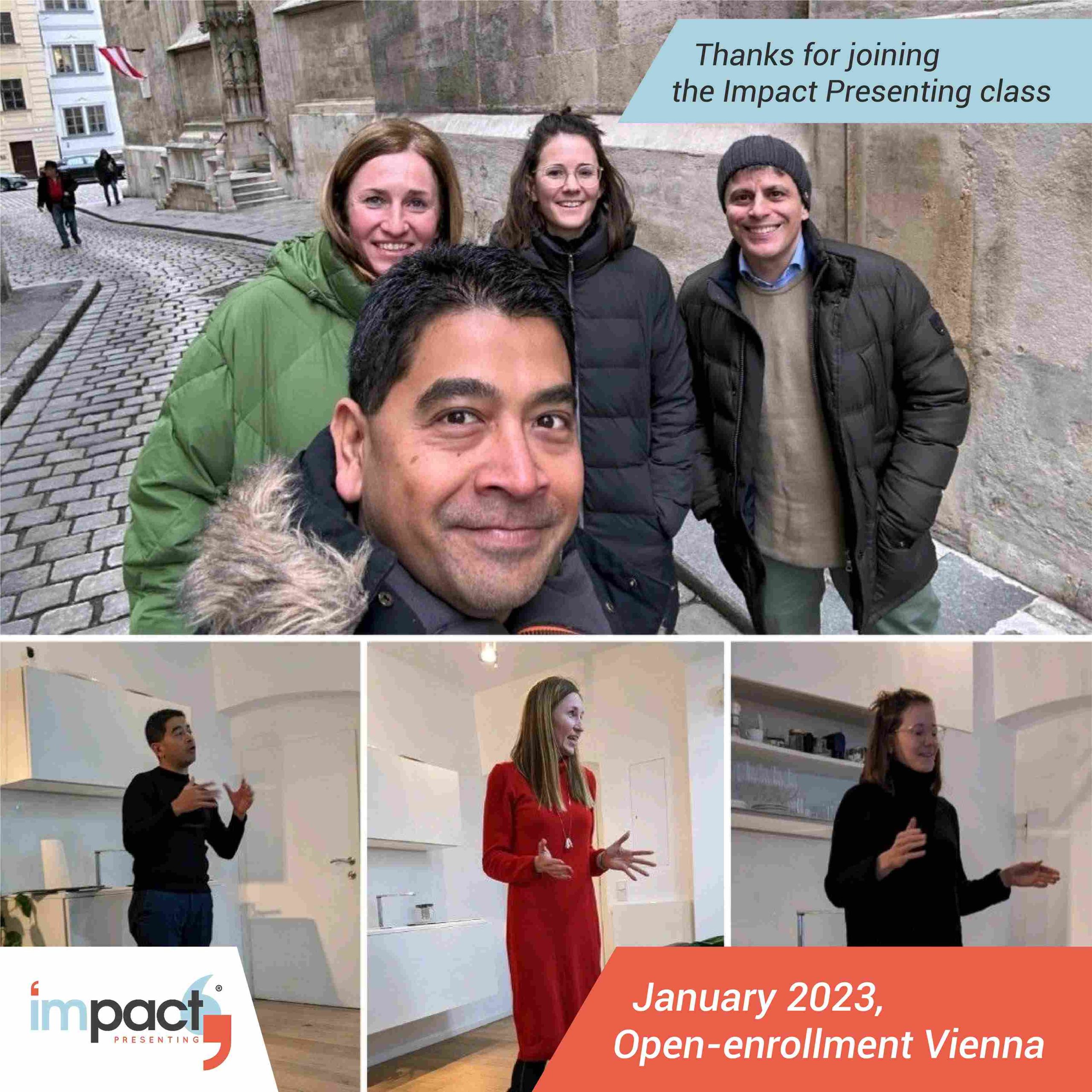
In January 2023, a small group of three professionals from different industries gathered in Vienna for our first open enrollment presentation skills course in the city. With only three participants, everyone received extensive personalised attention across both days.
Day 1 focused on structure: moving away from the “tell them everything that’s nice to know and hope they understand it” approach. Using the AUDIENCEE Model, participants learned to analyse their audience first, then build a brain-friendly message. The session covered strong openings and closings, storytelling for engagement, and physical delivery — eye contact, hand gestures, vocal projection, pacing, pauses, and using stage space effectively.
Day 2 was entirely practical. Participants presented in a safe, supportive environment and received individualised feedback. By the end, one participant who had previously struggled with nervousness reported that the course helped her manage her anxiety and feel genuinely comfortable in front of a group. Another discovered that storytelling transformed his delivery — and his ability to read and adapt to his audience in real time.
The feedback was consistent: participants left feeling not just more skilled, but more eager for their next opportunity to present.
The Cross-Industry Class: Four Professionals, Four Backgrounds, One Method
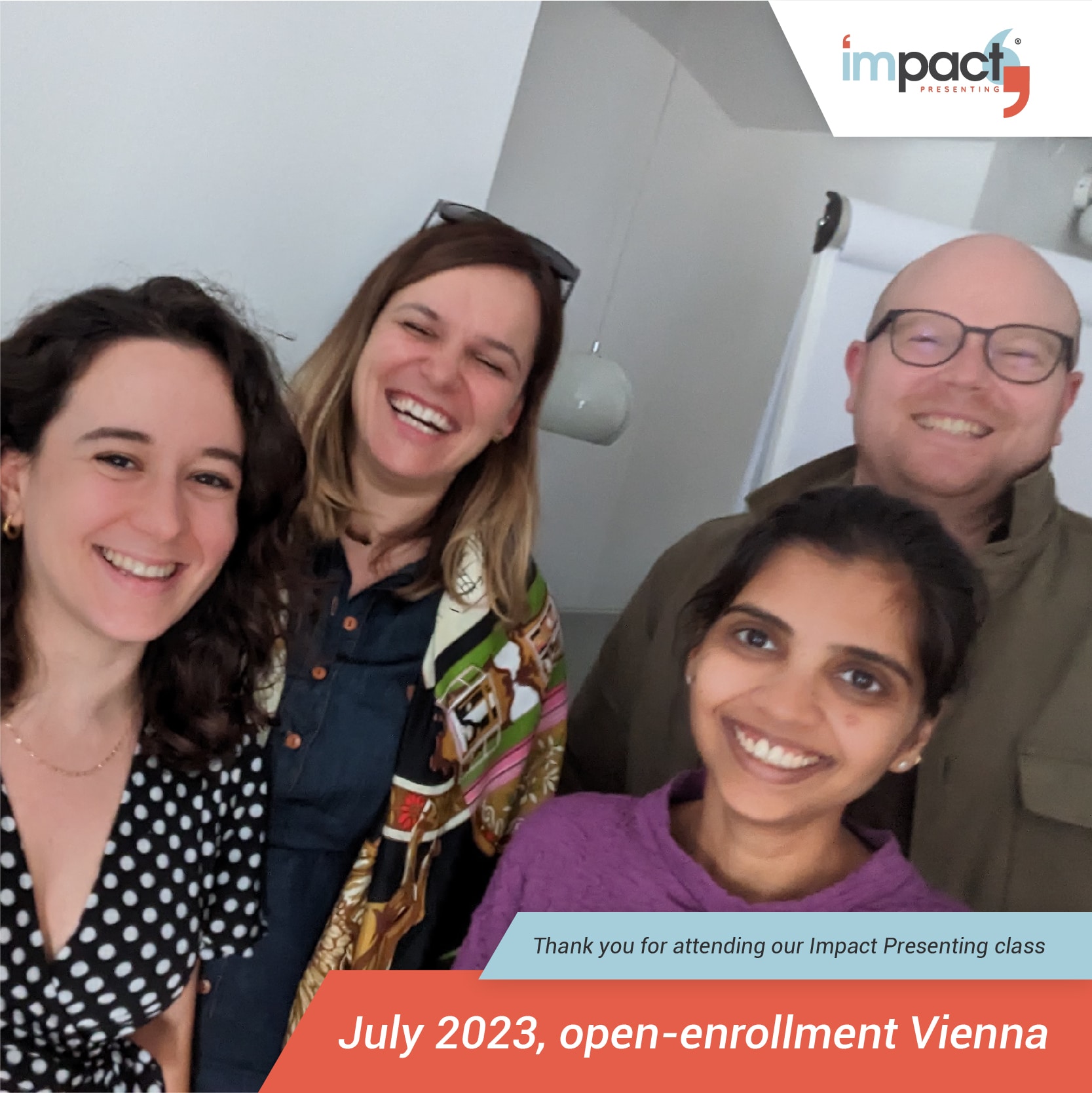
A later Vienna session brought together four professionals from entirely different fields — proof that presentation challenges cut across industries.
A. worked at a pharmaceutical company in Vienna. His presentations were technically accurate but dense. Internal review meetings had turned into monologues of clinical data
E. was a consultant at a major firm in Berlin. She presented to clients regularly, but feedback told her the same thing: her slides carried the message, she didn’t.
A. was a software engineer from Romania. He could explain architecture to other developers without difficulty. But when presenting progress updates to non-technical stakeholders, his message got lost.
R. was a tech specialist from Germany, occasionally asked to represent her company at industry events. She prepared thoroughly, but her delivery was stiff and scripted.
The Impact Presenting 4-Step Method in Action
Step A — Anxiety, Authenticity, Audience. The group addressed nerves openly. A. from pharma admitted he over-prepared to compensate for anxiety, which made his presentations longer, not better. E. relied on slides as a safety net. Using the AUDIENCEE Model, each participant mapped out who they were actually speaking to and what those people needed to hear.
Steps B+C — Brain-Friendly Content and Call-to-Action. Each participant rebuilt a real upcoming presentation from scratch. A. from pharma replaced data-heavy slides with three key visuals that told the story of a drug trial in human terms. A. from Romania learned to frame technical updates around outcomes rather than architecture — a shift especially valuable for professionals who need to communicate specialised subjects to non-expert audiences. Every presentation was rebuilt to close with a clear call-to-action.
Steps D+E — Deliver with Enthusiasm, Dare to Engage. E. practised presenting without slides for the first time. R. worked on loosening her scripted delivery by responding to live prompts. Both worked on body language, vocal pacing, and techniques for involving the audience through questions and interaction.
Step F — Finish, First Steps, Feedback. Each participant delivered a final presentation and received structured feedback from the group, focused on landing a clear closing and defining specific areas to keep working on.
What Changed Afterwards
A. from pharma shortened his internal presentations by half.
E. presented a client proposal the following week without using her slides.
A. from Romania started framing his reviews around business impact rather than technical detail. .
R. gave a conference talk six weeks after the class. She opened with a short personal story instead of an agenda slide.
The Persuasion Class: Why Facts Alone Never Convince Anyone
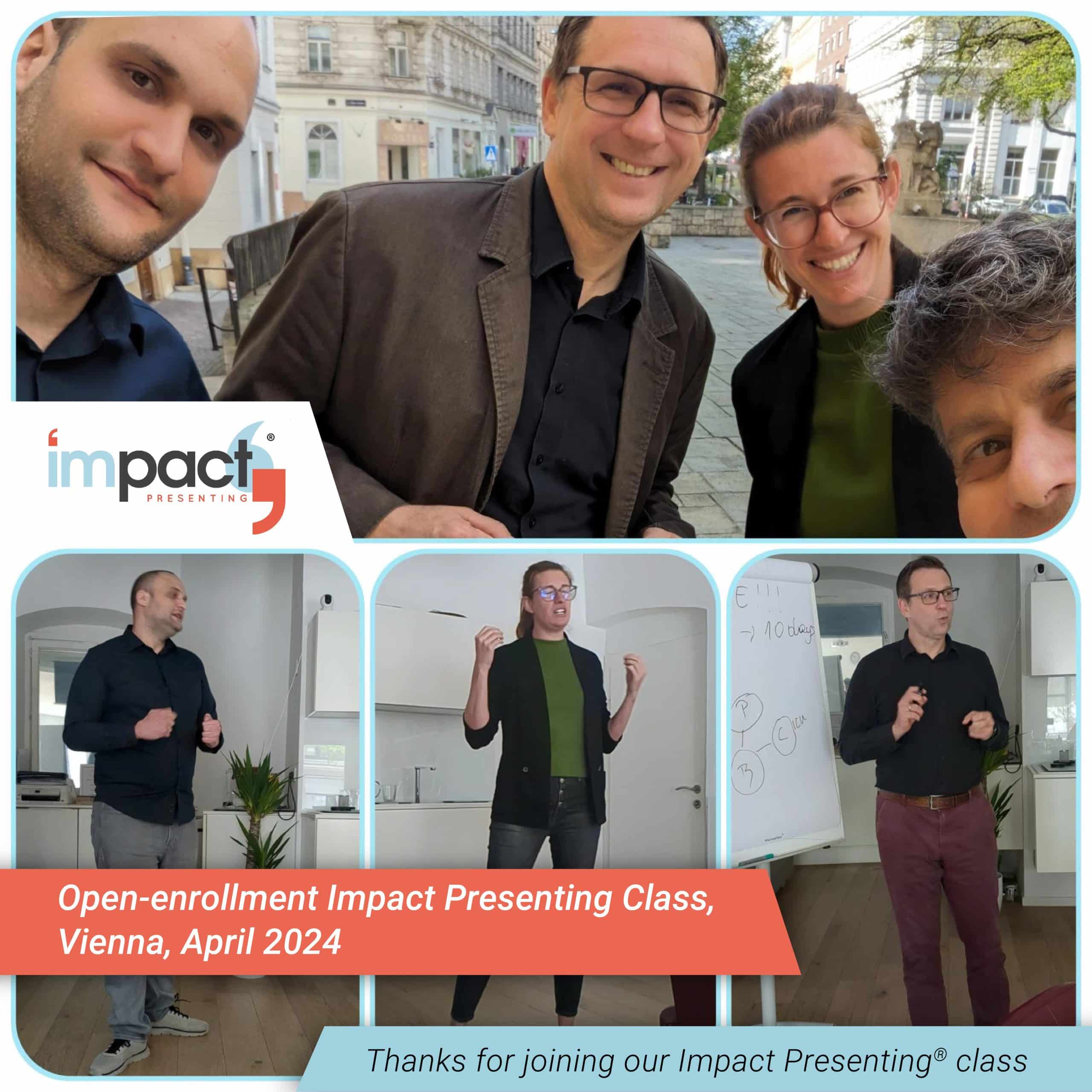
A more recent Vienna class brought together another group of four — an attorney from a global NGO, an engineer, a value chain specialist, and a marketing analyst. Each arrived with strong subject expertise. What they lacked was a structure for turning that expertise into presentations that moved people to act.
The Reframe That Changed Everything
On Day 1, Eric asked the group the question he asks every class: “What is the goal of the presentation you are working on?” The answers were variations of “to inform my audience about X.”
His follow-up: “If your goal is just to inform them, why not send the slides by email?”
This landed differently for each participant. M., the marketing analyst, realised her quarterly reviews were structured as data dumps. The attorney recognised she was building legal arguments without ever connecting them to what her audience actually cared about. The reframe was the same for everyone: you are not there to deliver information. You are there to move people toward a decision.
Heart, Head, and Cred
The framework participants used to restructure their presentations comes from the Persuasion Pyramid:
Head (Logos): The data and logic. Every participant already had this covered. The engineer had no shortage of evidence. But logic alone does not create urgency.
Heart (Pathos): The emotional connection. The engineer practised replacing a results slide with a short story about what the data meant for her team’s daily work. The same information, delivered as a narrative, held attention in a way the chart had not.
Cred (Ethos): Credibility through preparation and honesty. The value chain specialist restructured his opening to reference his direct experience running a pilot, rather than citing industry benchmarks. The group’s feedback was unanimous: they trusted him more when he spoke from his own work.
As the book Impact Presenting puts it: “If logic is missing, the analytical members will not buy in. If emotional impact is missing, they will not feel urgency. If credibility is missing, you will not be taken seriously.”
Day 2: Delivery and Practice
On Day 2, participants delivered their rebuilt talks to the group with new, more powerful openings and business storytelling. Participants filmed themselves on their phones and, instead of being left with a cringe-worthy recording, they now had a clear plan for how to use those recordings to keep improving after the class.
Why the Mixed-Group Format Works
The presentation skills course Vienna with a mixed group has a practical advantage that in-house corporate training cannot easily replicate: participants present to people outside their industry. A pharmaceutical researcher has to make clinical content understandable to a software engineer. A marketing analyst has to hold the attention of an attorney.
The small group size also means each person presents multiple times over two days. Feedback is immediate and specific — a level of personal attention that larger training programmes rarely match.
For those who identify as introverts or find presenting draining, the format also addresses energy management and preparation strategies that reduce anxiety well before stepping on stage.
“I had a long-lasting wish to have a Presentation Skills Class with a native speaker. It was not easy to find somebody in my part of Europe, but when I saw the possibility in Vienna, I immediately applied. It met all my expectations — it was lively, with practical examples. We got many tips about how to relax before going on stage, how to open our speech, and what to do with our hands. I can only recommend this training to anybody who would like to practice speaking in front of people.” — A.L., Prague, Czechia
Join Our Next Vienna Class
Our presentation skills course Vienna runs regularly, with small groups of four to six participants. Places fill up quickly and are offered on a first-come, first-served basis.
View the open enrollment schedule to book your place, or reach out and we will notify you when the next Vienna date is confirmed.
For teams of three or more, Impact Presenting In-House brings the full programme to your location, tailored to your industry and goals.
FAQ
Who typically attends the presentation skills course in Vienna?
Professionals from a range of industries and countries across Central Europe. Recent groups have included pharmaceutical researchers, management consultants, software engineers, attorneys, and marketing analysts. The mix of backgrounds is part of what makes the feedback so valuable.
I already present regularly. Will I still get something out of it?
Yes. Many of our participants are experienced presenters who want to move beyond slides-and-data and learn how to make their message land with different types of audiences.
Can I attend with a colleague?
Absolutely. Individuals and pairs are welcome in our open enrolment classes. If you have a group of three or more, our in-house programme may be a better fit.
How do I find out when the next class is?
Contact us and we will notify you as soon as the next Vienna date is confirmed.
How large are the groups?
Classes are deliberately kept small, with 3 to 6 participants. This ensures extensive personal coaching and multiple rounds of on-stage practice for every attendee.
What makes this course different from online presentation training?
Presentation skills are performative — they require live practice and real-time expert feedback. Our 2-day intensive format gives you a structured framework on Day 1 and dedicated stage time with individualised coaching on Day 2, something no online course can replicate.
Is the course suitable for non-native English speakers?
Absolutely. Many of our Vienna participants present regularly in English as a second language. The course addresses the specific challenges of communicating in multilingual professional environments, including clarity, pacing, and audience adaptation.
How can I book an open enrollment class or arrange in-house training?
View upcoming open enrollment classes or enquire about in-house training for your organisation directly on our website.