
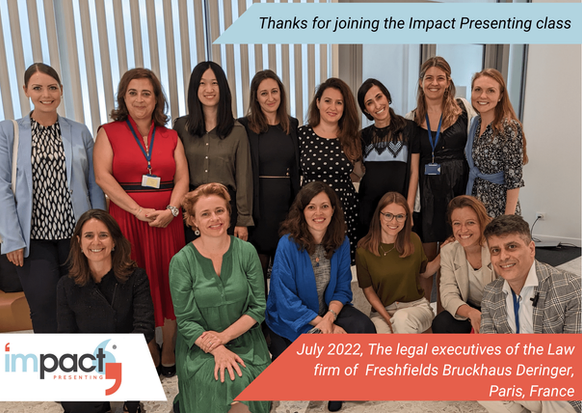
Executive Presence Training for Women — Paris Law Firm Seminar
A half-day programme for 35 female legal professionals at Freshfields Bruckhaus Deringer
In early 2022, Freshfields Bruckhaus Deringer commissioned a half-day executive presence training for women at their Paris office. The programme was designed for 35 female legal professionals, ranging from associates to senior counsel, and focused on four core areas: overcoming impostor syndrome, moving beyond PowerPoint, confident vocal and physical delivery, and managing speaking anxiety.
The session was led by Eric Molin, founder of Impact Presenting. While selecting a male trainer for a female-focused programme was unconventional, Freshfields specifically valued the perspective of someone who regularly sits “on the other side of the table” in high-stakes legal and corporate settings.
Impostor syndrome and the 4 R’s
The programme opened with a structured approach to impostor syndrome, a pattern particularly common among high-achieving women in competitive professional environments. Rather than treating it as a personal failing, Eric introduced the 4 R’s framework from the Impact Presenting methodology:
- Recognise the pattern when it surfaces (before a meeting, after a successful outcome, during peer comparison).
- Remember concrete achievements. Participants were asked to list three professional wins from the past twelve months.
- Reframe the internal narrative. The goal is not to eliminate doubt, but to separate fact from feeling.
- Refocus on preparation and process rather than perceived judgement.
This framework gave participants a repeatable tool, not a one-time motivational exercise.
Beyond PowerPoint: the Assertion-Evidence approach
The second module addressed a common weakness in legal presentations: over-reliance on text-heavy slides. Eric introduced the Assertion-Evidence Model, where each slide carries a single sentence-style headline (the assertion) supported by visual evidence rather than bullet points.
For legal professionals accustomed to dense documentation, this required a significant shift in thinking. The guiding principle, “if in doubt, leave it out,” forced participants to identify the one point each slide needed to make. Eric also demonstrated alternatives to slides entirely, including structured use of flipcharts and whiteboard mapping for smaller strategy meetings, and business storytelling techniques drawn from the Persuasion Pyramid (Logos, Pathos, Ethos) to connect with non-legal audiences.
Voice, body language, and nonverbal authority
The third module focused on delivery. Eric explained that research consistently shows nonverbal cues (posture, facial expression, vocal tone, pacing) have a measurable impact on how speakers are perceived. For women in male-dominated environments, awareness of these signals is particularly valuable.
Participants practised:
- Voice projection exercises designed for conference rooms, not stages.
- Deliberate use of pauses to convey authority rather than rushing through content.
- Open posture techniques that communicate confidence without mimicking aggressive body language.
The emphasis was on authenticity. The goal was not to adopt a persona, but to remove habits that undermine the presence participants already have.
Managing nerves: preparation over performance
The final module applied the anxiety management component of the Impact Presenting methodology. Eric reframed speaking anxiety as a preparation problem rather than a personality trait, and introduced practical techniques:
- Structured rehearsal methods (timed run-throughs rather than reading notes silently).
- Controlled breathing techniques borrowed from performance psychology.
- Success visualisation, focusing on the first 60 seconds of a presentation to build momentum.
Participants were encouraged to treat every internal meeting as low-stakes practice for higher-pressure moments.
Outcomes
The participants left with a concrete toolkit applicable to their daily work: a framework for managing self-doubt, a method for designing clearer slides, physical techniques for projecting confidence, and a structured approach to preparation. Several participants noted that the cross-gender perspective added unexpected value, particularly in understanding how communication styles are perceived in mixed-gender leadership settings.
Freshfields delivered this programme as an in-house training. Impact Presenting also offers open enrollment courses for individual professionals looking to develop executive presence and presentation skills.
FAQ
Is executive presence training only for senior leaders?
No. The Freshfields programme included professionals at all levels, from associates to senior counsel. Developing these skills earlier in a career compounds their impact over time. The frameworks taught (the 4 R’s, Assertion-Evidence, structured rehearsal) are equally relevant for someone preparing their first board presentation or their fiftieth.
Why choose a male trainer for a women-focused programme?
Freshfields valued an external perspective on how communication is received across the table in negotiations, pitches, and leadership meetings. The training focuses on observable skills and evidence-based techniques, not gender theory. Participants found this practical, results-oriented approach highly effective.
Can this programme be adapted for other industries?
Absolutely. The Impact Presenting methodology has been delivered across pharmaceuticals, technology, finance, and academia. The core frameworks are universal. Programmes are available as in-house training or through open enrollment courses.